




Maneki Neko, Daruma, Masks & Samurai Armor — Japanese Good Luck Symbols & Cultural Objects
The four objects that carry Japan's most enduring symbols into a home — Maneki Neko for prosperity, Daruma for resolve, Japanese masks for protection, samurai armor for honor. Each piece is the symbol made physical.


Japanese symbols don't sit on paper. They sit on objects, in homes, on shrine gates, at the entrance of restaurants — chosen carefully, placed with intention, looked at every day until the meaning becomes part of the room. The Maneki Neko at the entrance of every Tokyo shop, the Daruma on the desk of every student preparing an exam, the kabuki mask above the doorway, the samurai armor in the family alcove — these are the Japanese symbols and meanings that survived three centuries of modernization without being demoted to decoration.
This collection brings the four most enduring categories together. Seventy-two objects, four distinct symbol families, one principle: a symbol you hold in your hand outlasts any tattoo or print. Whether you're after Japanese symbols for love and prosperity at the entrance, Japanese symbols for strength on a desk, Japanese symbols for protection above a door, or Japanese cultural symbols for a serious collection — every meaning here is carried by an object built to last.
Maneki Neko — The Japanese Symbol for Luck & Prosperity
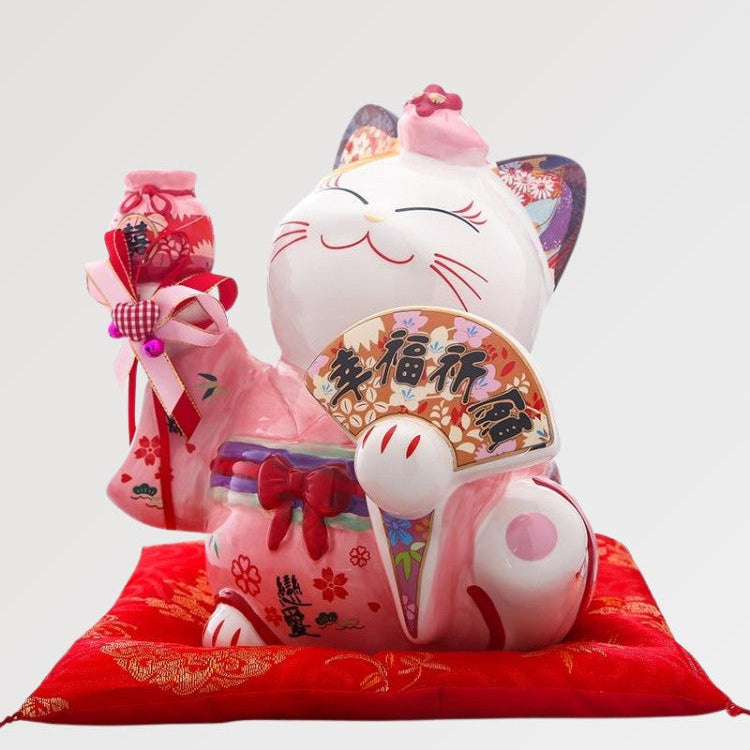
The Maneki Neko ("beckoning cat") is the most reproduced Japanese symbol on the planet. You've seen it at the door of every sushi restaurant, every dim sum house, every Asian grocery — one paw raised, gold ingot in front, calling fortune in. The left paw raised brings customers. The right paw raised brings money. Both paws raised brings everything at once — and is increasingly common in modern variants.
What most Western buyers don't know: the cat's color is also a symbol. The classic tri-color (calico) is the original — symbol of pure luck. White stands for happiness and purity. Black wards off evil spirits and was traditionally placed in women's bedrooms as protection. Gold is wealth. Red blocks illness. Pink brings love. Our Maneki Neko collection covers all six color codes — choose by the kind of luck you actually want. The Maneki Neko is also the most common Japanese good luck symbol given as a gift, especially for a business opening, a new home, or a milestone. The object carries the wish out loud, so the giver doesn't have to.
Daruma — The Japanese Symbol of Resolve & Goals
The Daruma doll is the symbol of perseverance — modeled on Bodhidharma, the Buddhist monk who legendarily meditated facing a wall for nine years until his arms and legs withered away. The doll is round, weighted at the base, and pops back upright when knocked over: nanakorobi yaoki — "fall seven times, stand up eight." That phrase, more than any kanji, is the meaning the Daruma carries.
The ritual is what makes the Daruma a Japanese symbol of strength rather than just an ornament. You buy a Daruma with both eyes blank. You paint one eye in while making a goal — a wedding, an exam, a year of sobriety, a business launch. The Daruma watches you with one eye until the goal is reached. Then you paint the second eye. The Daruma is the only Japanese symbol for hope that actively keeps score.
Daruma colors vary: red (the original, against illness and bad luck), gold (wealth), white (love and harmony), purple (self-improvement), black (protection). Our collection covers the full color range and three traditional sizes — small for desks, medium for shelves, large for prominent placement.
Japanese Masks — Theatrical, Protective & Symbolic Faces
Japanese masks (men) are one of the deepest symbol families in the culture, and the most varied in this collection. Three traditions cover almost everything.
- Noh and Kyōgen masks come from classical theater, carved from cypress wood and lacquered. The Hannya mask — horned, fanged, a woman transformed by jealousy — is the most recognized worldwide and the most loaded as a Japanese symbol of death and emotional intensity. Other Noh masks include the young woman (ko-omote), the old man (okina), the demon (shikami). Each one is a fixed character with a fixed meaning.
- Kabuki masks are bolder, painted not carved, designed to read from the back rows of the theater. They reach back to the Edo period and carry the iconography of warriors, demons, gods, and supernatural beings.
- Oni and folk masks — Oni (demon), Tengu (long-nosed mountain spirit), Kitsune (fox) — are protective masks worn at festivals and hung above doorways. The Oni mask, in particular, is the Japanese symbol for warding off evil spirits: you place the demon at the threshold so worse demons turn back.
A Japanese mask on the wall is not decoration. It's protection by reputation — the household signals which spirits it has already invited in.
Samurai Armor — The Japanese Symbol of Honor & The Warrior Code
The samurai armor (yoroi) is the most ambitious Japanese symbol in this collection. Each piece is a full-scale traditional armor — lacquered iron plates, silk lacing, helmet with crest (kabuto), face mask (menpō) — built to the specifications of the late Sengoku and Edo periods. These are display pieces for serious collectors, gallery installations, and homes where one statement piece does the work of an entire room.
The samurai armor carries the iconography of bushidō — the warrior's code: loyalty, honor, courage in the face of death, mastery of the self. As a Japanese symbol of warrior identity, nothing rivals it. The crest on the helmet (maedate) varied by clan — dragons, antlers, suns, kanji — each one a Japanese cultural symbol in its own right, mounted at the forehead so it would be seen first in battle. Modern samurai armor reproductions are not costume — they're scaled, weighted, lacquered, laced, and assembled to the original specs. The price reflects the craftsmanship: each armor takes hundreds of hours to build. Whether you're collecting, decorating a serious office, or building a home gallery of Japanese cultural objects, the samurai armor sits at the top of the hierarchy.
Japanese Symbols by Meaning — Love, Strength, Peace, Fire & More
Beyond the four main object families, the collection carries the iconography of dozens of secondary Japanese symbols and meanings. A short guide to the ones most often searched.
- Japanese symbol for love — 愛 (ai) is the kanji; the crane (tsuru) and the mandarin duck pair are the animal symbols. Cranes appear on noren, prints, and Daruma variants. The mandarin ducks are paired for life, which is why they show up on wedding gifts.
- Japanese symbol for strength — 力 (chikara) is the kanji; the tiger and the dragon are the animal symbols. Tiger appears on masks and armor crests. Dragon appears across prints, masks, and as the iconographic crown on Daruma collectibles. The Japanese dragon tattoo symbolism — which is why so many of our visitors are tattoo-curious — comes from this same family.
- Japanese symbol of peace — 平和 (heiwa) is the kanji; the dove and the lotus flower are the visual symbols. Both appear on prints and lanterns.
- Japanese symbol for fire — 火 (hi) is the kanji; the fox spirit (kitsune) is closely linked to fire in folklore. Kitsune masks are part of this collection's fire-symbol family.
- Japanese symbol for death — 死 (shi) is the kanji, but the Hannya mask and the chrysanthemum (the imperial flower, also funerary) carry the visual weight. The Japanese symbol for dead is rarely chosen as a primary motif but appears in the deeper iconography of Noh theater.
- Japanese symbol for family — 家族 (kazoku) is the kanji; the crane again, the pine tree, and the turtle (longevity, multi-generational) are the symbols.
- Japanese symbol for courage — 勇気 (yūki); the samurai armor and the warrior masks are the embodied symbols. This is where the cultural symbols family overlaps with the warrior symbols family.
- Japanese cherry blossom symbolism — sakura is the symbol of impermanence (mono no aware) — the beauty of things precisely because they don't last. Cherry blossom prints, Daruma variants, and noren in this collection all carry it.
- Japanese crane symbolism — the crane (tsuru) is the symbol of 1,000 years of life, faithful love, and family longevity. The legend says folding 1,000 paper cranes grants a wish — senbazuru.
For Japanese tattoo symbols and Japanese tattoo symbolism researchers — the dragon, the koi swimming upstream, the cherry blossom, the crane, the Hannya mask — every major motif is represented somewhere in this collection.
Japanese Symbols and Their Meanings — Quick Reference
For visitors comparing Japanese symbols and meanings before buying, here's the essential cross-reference between meaning, kanji, and the object that carries it in this collection.
Luck and prosperity are carried by 福 (fuku) and embodied in the Maneki Neko — every color in the collection corresponds to a specific kind of luck. Resolve and goal-setting are carried by 達磨 (daruma) and embodied in the Daruma dolls, with the two-eye ritual making the commitment visible. Protection against evil spirits is carried by 鬼 (oni) and embodied in the Oni and Tengu masks placed at thresholds. Honor and the warrior code are carried by 武士道 (bushidō) and embodied in the samurai armor.
Beyond the four core symbol families, the secondary meanings appear across the catalog. Love is carried by 愛 (ai) — embodied in crane motifs and mandarin duck pairs on prints, noren, and Daruma variants. Strength is carried by 力 (chikara) — embodied in dragon and tiger crests on masks and armor. Peace is carried by 平和 (heiwa) — embodied in dove and lotus motifs. Fire is carried by 火 (hi) — embodied in Kitsune fox masks tied to fire folklore. Courage is carried by 勇気 (yūki) — embodied in samurai armor and warrior masks. Longevity is carried by 鶴 (tsuru) — embodied in crane imagery on Daruma and noren, with the legend of senbazuru (the thousand paper cranes) running through it. Wisdom is carried by 智 (chi) — embodied in Buddha references throughout the Daruma lineage. Death and mortality are carried by 死 (shi) — embodied most directly in the Hannya mask and chrysanthemum motifs.
This reference covers the core Japanese symbols and their meanings — the kanji you'll see on copy-and-paste lists, the meaningful symbols actually carried by physical objects, and the cultural symbols Japan still uses every day. The objects in this collection are the form these meanings take when they leave the page and enter a room.
Why Object Symbols Outlast Written Symbols
A kanji on a copy-and-paste site lives for the duration of one tab. A Maneki Neko on a counter lives for twenty years. Japanese culture has always treated objects as the most durable form of symbolism. A scroll changed with the season carries meaning more deeply than a sentence read once. A Daruma on a desk renews a goal every time the eye crosses it. A samurai armor in a study reframes the room before anyone speaks. The reason Japanese symbols and meanings have transmitted across a thousand years isn't because the kanji are beautiful — it's because Japan attached every meaning to an object that someone had to make, place, and live with. That's the collection in one sentence: meaning made physical, then placed where it can do its work daily. Pick the object before you pick the kanji.